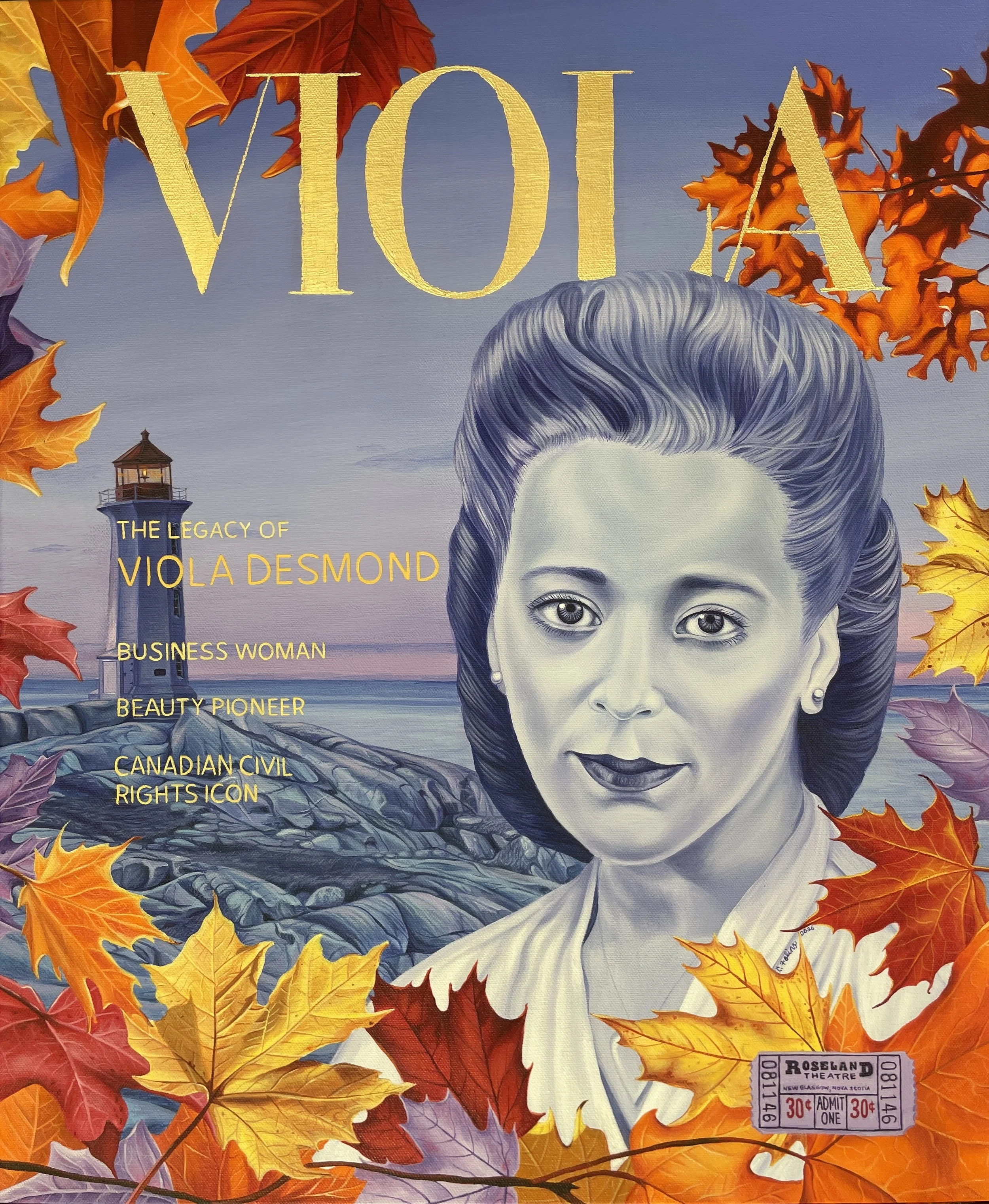
Viola
Viola Description:
I chose Viola Desmond, successful Nova Scotian business woman and civil rights advocate, as the subject of my latest painting. Most Canadians will recognize her as the attractive face that graces the ten dollar bill, but long before the banknote, she was challenging racism and segregation in Nova Scotia and empowering Black women through her beauty salon, cosmetics line, and beauty school. While Canadian civil rights icons often get overshadowed by their American counterparts, Viola Desmond’s story is one that reflects the Canadian experience and spirit: it is rooted in truth, strength, and resilience.
Desmond is most known for refusing to leave her seat in a “white’s only” section at the Roseland Theatre in New Glasgow, Nova Scotia. Racial segregation was common in 1946 and although Desmond requested to buy a ticket for the main floor of the theatre, she was instead given one for the balcony.
While Desmond thought the cashier had made a mistake, the cashier made it clear that she was to adhere to the segregated seating. Desmond still chose to sit in the main section of the theatre and was then forcibly removed, escorted out of the theatre and put in jail for the night. She was ultimately charged with tax evasion, the main floor tax being one cent more than the balcony, and charged $26.
Desmond went on to challenge the charges in court, despite not being given a lawyer or even informed of her legal rights to one. Eventually she took her case to the Supreme Court, but in the end, her conviction stood. Although Viola Desmond did not get the justice she deserved at the time, her refusal to accept this blatant racism and unjust treatment made her a civil rights advocate and shed a spotlight on the reality of racism in Canada.
Desmond never lived long enough to be honoured for her act of courage and it wasn’t until 2010, that the government of Nova Scotia issued a formal apology to her and her family. Since then, she has been featured on a commemorative stamp series and in 2016, became the first female and Black Canadian woman to appear on a banknote.
During her trial in 1946, Desmond received support from the Nova Scotian Association for the Advancement of Coloured People (NSAACP) and Carrie Best, owner of a Black-owned newspaper, The Clarion. Desmond’s case made front page news in this paper and exposed the racist attitudes and practices that were rampant in Nova Scotia at the time. Desmond’s refusal to be treated like a second-class citizen and the community support she received definitely had an effect on the fight against racism in Nova Scotia and helped pave the way for the right to equality for all in Canada.
While Viola Desmond’s legacy is most notably tied to her refusal to sit in the segregated balcony of a movie theatre, she also had an undeniable impact as a beauty salon owner and a cosmetics pioneer. She taught for a time in segregated schools, and then she eventually opened up her own beauty salon and school. In doing so, she provided entrepreneurial opportunities to black women who had been largely excluded from the beauty industry.
Desmond also developed her own line of beauty products including face powder and hair treatments. As a result of the Eurocentric focus on beauty culture, most products designed for Black women had to be ordered from the United States. Desmond’s salon, school, and products challenged the racist system that tried to erase Black women from public life. In this regard her legacy is two-fold: she called out a racist system by refusing to adhere to segregated seating and she instilled confidence, respect and entrepreneurial experience in women who had been denied that in their own province and country. This is why she was an obvious choice as the subject of my painting.
As a result of Desmond’s contribution to beauty culture, I modelled my composition in my artwork after a Vogue cover, substituting the word “Vogue” for “Viola”. I used gold leaf to give it a luminous quality and a sense of glamour. The gold lettering also contrasts well with the purple monochromatic background and portrait of Desmond. Since most Canadians associate her image with the ten dollar banknote, I wanted to reinforce that connection by using purple hues in the majority of the painting.
The lighthouse in the background is representative of Peggy’s Cove in Halifax, Nova Scotia. Since Desmond was raised in Halifax, this is a nod to her early years. The border of maple leaves symbolizes her Canadian heritage and provides a warm contrast to the monochromatic purple tones. I alternated yellow, orange, red, and purple maple leaves to draw your eye into the portrait even more, unify the composition, and balance the colour choices.
The ticket in the bottom right-hand corner represents the movie ticket from Roseland Theatre and underscores what became the inciting incident to Desmond’s fight against racial injustice. The numbers that appear on the edges of the ticket reflect the date she went to the theatre: November 8th, 1946. This helps give the viewer context and a time frame for her story. I also positioned the ticket in this corner to mimic where you might expect to see a barcode on a magazine cover. It also diagonally balances the overhanging leaves in the top left corner of the composition.
My intention with “Viola” is to honour and celebrate an inspiring Canadian woman who not only took a stand to abhorrent racist behaviour during a time when that was the norm, but also helped give black women a confidant voice, industry training, and financial fortitude in a beauty industry that had almost entirely erased their presence. So while many take for granted the portrait they carry of her in their wallets, my purpose with this artwork is to showcase Viola Desmond on the “cover” of a magazine like the Canadian business woman, beauty pioneer, and civil rights icon that she is.